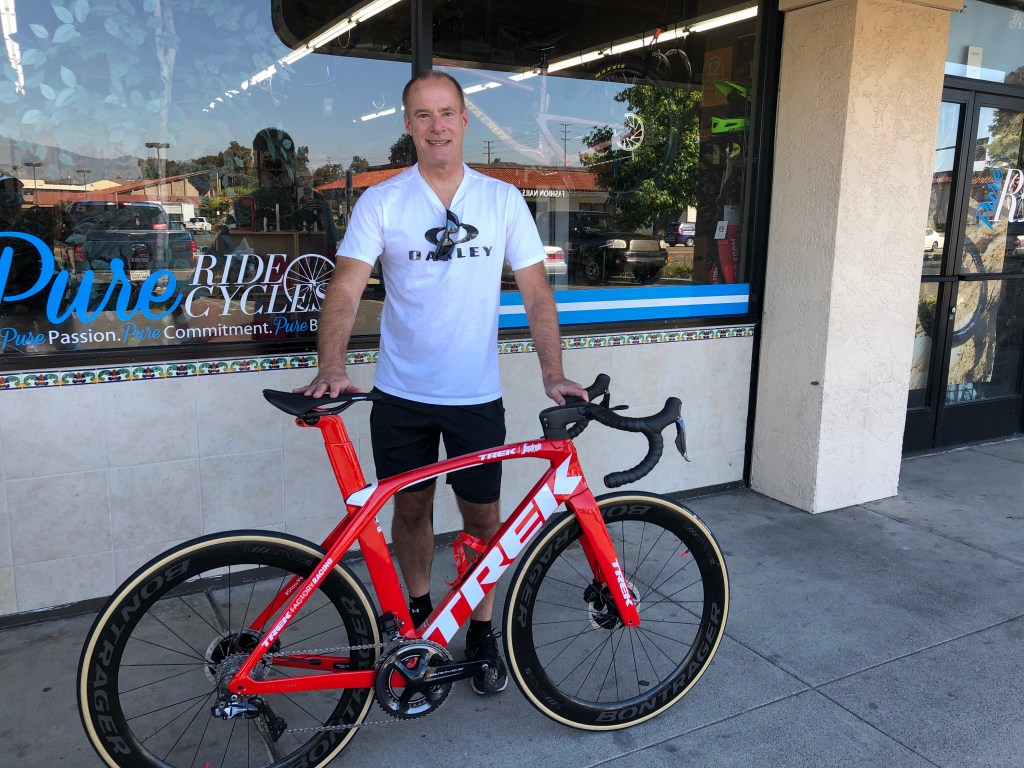
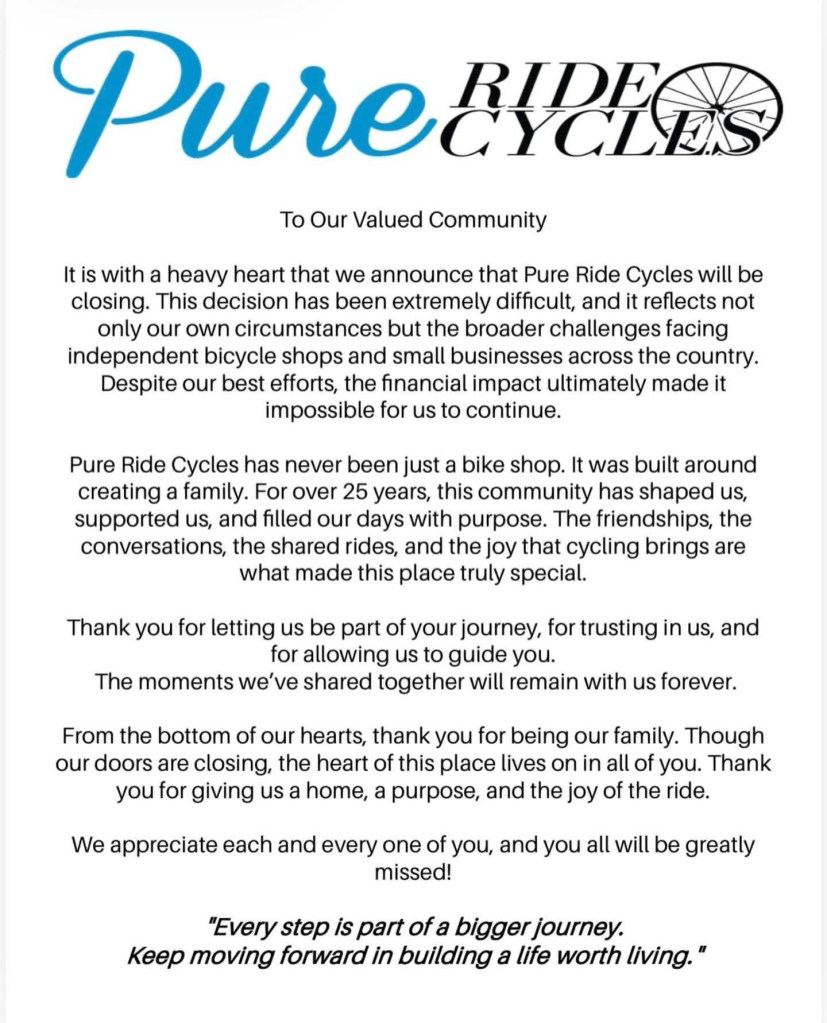
Very sad to say that over this past weekend my local bike shop, Pure Ride Cycles (LBS see this post) shut their doors, permanently. One could see the handwriting on the walls along with the slowly decreasing inventory as first one-brand, Cervelo, was custom-order only. Then Santa Cruz was just gone from the showroom. Liv made a slow departure. Then finally all that was left were a few Giant and the shop ‘anchor’ Trek.
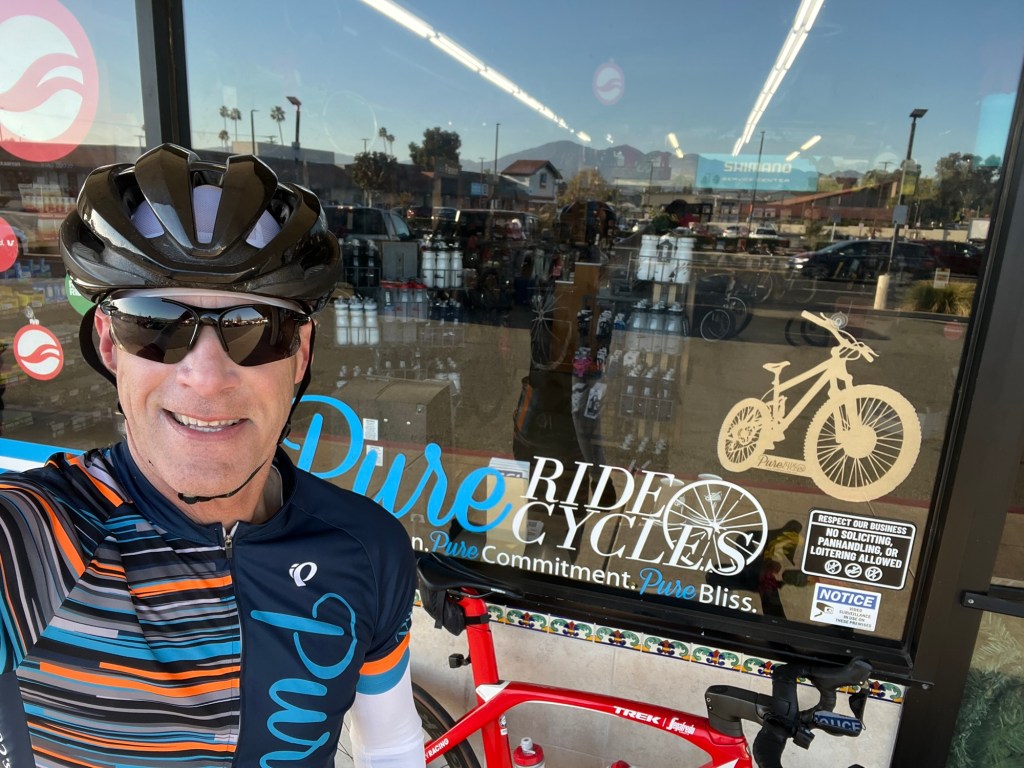
Kristen, the owner, poured her heart and soul into the business and more importantly the local cycling community. I couldn’t begin to count the number of young kids who got their introduction to cycling, recreationally, sporting, and competition through Kristen’s tireless efforts to encourage more people to; get out and ride bikes. I certainly appreciate all the time she took with my wife over the years to get her properly fitted and kitted for cycling.
Bike fit really makes a difference for everyone, especially women, who have a hard time explaining their issues to their sometimes thickheaded husbands. And Kristen was without a doubt one of the finest bike-fitters in Orange County, CA. A huge loss to the community that goes completely unnoticed to the casual observer of local, regional, and national business trends.
I am not about to commit heresy to suggest that #datacenters are responsible for the on-going closures of countless local business. There are numerous factors at play especially here in California where one politician or another pushes through yet another mandate for some category of worker to ‘make a living wage’ thereby pushing up the wage base for everyone far ahead of the normal economic process. Tack on staggering costs for energy, local business taxes, and an innumerable stack of every changing business permits, policies, compliance requirements and it is no wonder local small businesses have a difficult time.
And now for the datacenter play; post Covid (Covid was phenomenal for bike shops as everyone wanted something to do outside) it seems many of the major bike brands decided they needed to market direct-to-consumer. You can look to Canyon bicycles for pioneering this concept of eliminating the local bike shop / dealer in the purchase process and now you, yourself become liable for assembling the bike incorrectly, loosing control of the bike, and any damages your may cause to yourself and/or others. The e-commerce marketing of bicycles was about to go full-scale, quickly.
Not only did most of the leading brands jump onboard but they did so by hooking their local dealer base into the process as a deeply discounted net value to the dealer. So instead of walking into your local bike shop, talking to one of many seasoned, trained experts on bike type (road, mountain, city, commuter, hybrid, tandem, etc.) you know were on your own to parse through all sorts of YouTube videos, manufacture web sites, and hopefully seek advice from a knowledgable cycling friend, all to select the type of bike and then wait – determine the proper size, components, gearing, etc. on your own.
Oh but ordering online saves you maybe $1,000 on a $6,000 retail bike. Yay, punch in the credit card and a few days to maybe months later your bike shows up at the local bike shop where their mechanics do the build for your. However, instead of 1, helping you select the right type of bike 2, determine the right size, gearing, pedals (oh everyone forgets bikes do not come with proper pedals) 3, shoes, helmet, gloves, cycling kit – all you receive is a fully assembled bike.
A bike that the dealer would have sold to you for exactly the same or perhaps a little bit less and made a profit of somewhere between $500 and $900 depending upon model, components, etc. Instead, and this is the big rub with direct-to-consumer marketing in the bicycle industry, the dealer only receives a flat fee of $200 – $250 for assembling your bicycle. And along with that takes on all sorts of financial risks / liability should you decide to exceed the safe-operating-area of the bike and sue them for negligence.
Now for my rant – if that wasn’t enough; along came e-bikes especially those called ‘Class II’ e-bikes that can be ridden by throttle alone, never turning a pedal. The Internet is flooded with these thinly veiled motorcycles. All sorts of well-intentioned people buy them for their kids (we don’t want to keep driving ginormous SUVs to take little jr. to school), their own use around town, errands, even commuting to work. However, the vast majority of these bikes are low-cost builds from China with questionable lithium-ion batteries, chargers, week brakes, poor geometry (made far worse with a second person/kid on the back), and all sorts of Torque / acceleration at the mere twist / push of the throttle. Who can blame new, untrained riders (at least totally clueless to the rules of the road for proper cyclists) from wanting to pop wheelies, flaunt traffic rules, run intersections, ride on the sidewalk because it is convenient, and all too frequently injuring or even killing themselves and others. See OC Veteran killed by e-bike rider.
In my humble opinion all Class II e-bikes should be banned. If the bike moves forward by throttle alone it creates far too much visual and tactical confusion to others using our streets, roadways, and sidewalks. When the bicycle operator can shoot forward at great speed or accelerate quickly with no visual reference as one expects from a bicyclist – the pedals turning, it creates unnecessary confusion and creates too much risk for all around.
Ok, back to our regularly scheduled blog – Pure Ride Cycles tried to stay upmarket on the e-bike wave focusing on the much more traditional pedal-assist-only Class I (typically mountain bikes but townies, commuters included) and the occasional Class III (29 mph max roadie- and I try to eat them for lunch when I see them on the road) and quickly moved away from the Class II, low-cost bikes. Bikes frequently (almost exclusively these days) purchased for on-line shopping services and their global network of data centers and mass merchandizers. With the advent of cheap, no-effort and often no brains required riding a huge section of the customer base was lost to cheap, online bikes.
A little too late for Pure Ride but many communities across the country are finally enacting policies and regulations limiting (but not outright banning) Class II e-bikes.
To Kristen and the entire team of dedicated professionals who were Pure Ride Cycles, you may be gone – you won’t be forgotten. Best wishes in your onward journeys.


Leave a Reply