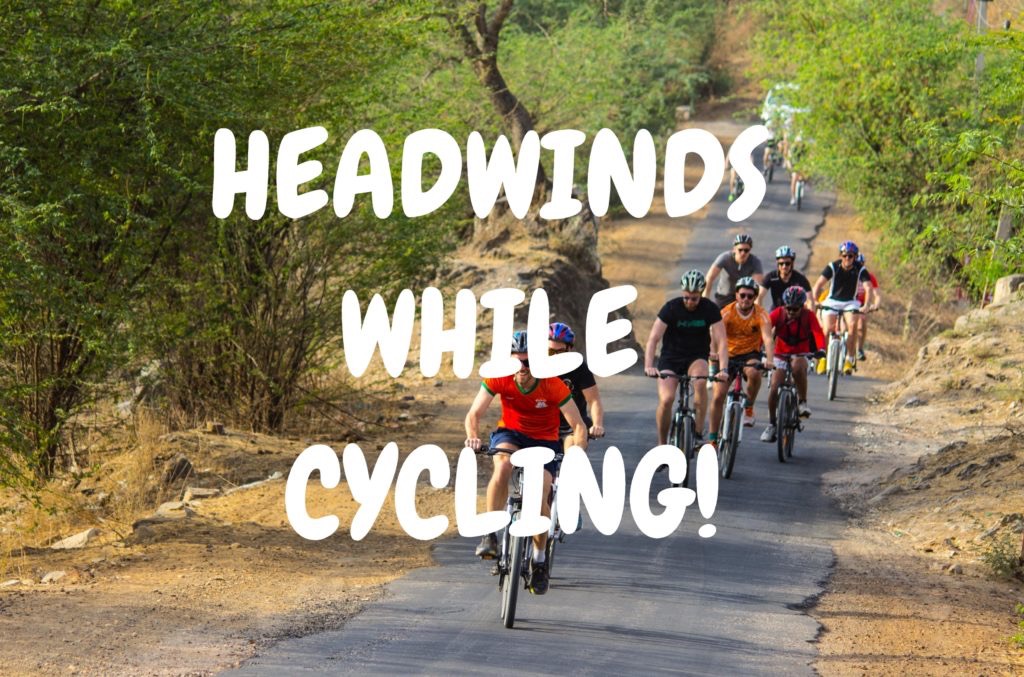
As if the term Headwinds wasn’t bad enough already for those of us who enjoy outdoor activities now it seems the entire business world has started bandying the word about whenever they have less than ideal market conditions. And that in a nutshell defines what headwinds are for cyclists – less than ideal riding conditions. When Ideal is defined as being able to go as fast as possible for the amount of energy / effort we want to expend.
One thing we know for certain, unless you intend to ride in one direction only you are going to run into a headwind sooner or later. So we may as well plan and train for the inevitable. So suck-it-up and get on with the training.
Let’s start with a few types and categories of headwinds. For types I think of them as head-on (or nearly head-on), quartering meaning about 45 degrees from head-on, and nearly sideways to sideways (90-degrees from point of travel still has a headwind component due to our own forward momentum. Plus it can just get nasty when gusty trying to push you across the road.)
Categories – much like hurricanes we all have our own definition of how hard / forceful the wind is and what we call it. At least what we can say in public. I’ll start with the most obnoxious, potentially dangerous winds we get here in SoCal, specifically south Orange County in the hills and canyons – Severe Santa Ana winds often with gusts in the 60 to 80 MPH. Best to avoid these if at all possible. I do recall a day my genius best friend (we’ll call him Jeff) and I decided we would just ride our mountain bikes. Safer! The trails are protected by trees, brush, the hills themselves. Yeah – right up until we had to ride some single-track across a ridgetop connecting two hills. We both got blown with such force we had to bail off the bikes as we were blown over the edge. We held on to the bikes and crawled our way back up. (yes, our wives know the story, albeit a few years later.)
Headwinds can vary from a gentle breeze to a nice steady wind of say 10 to 15 mph. Once the wind gets much over 20 you are in for a slog / suffer fest. No way around it.
Training – well it starts with finding and riding in a headwind. As noted above if you do any out and back or loop ride you will find a headwind. Now, instead of merely cursing your fate start developing some riding and mental techniques to make the most of this time.
Sure, everyone, books, coaches say – just get more aero! Yeah, a bit late for that. And if you are an older rider or just lack flexibility there is only so much you can do. Let’s start with the easy stuff. Relax! It is a headwind, congratulations you figured it out. And I bet you got a little more tense, gripped the handle bars tighter, and without knowing it your shoulders are slowly moving up to your ears.
Relaxing gives you some of that energy / power from your death grip, forearms, even pecs/lats back. Energy not wasted on a death grip can be used for power or reserve as the ride is going to be a bit longer at your new slower speed.
Relaxing your shoulders has a double benefit. 1, all that energy wasted is available and 2, bringing your shoulders down deliberately will make you more aerodynamic. The two combined will improve your frame of mind. A third, big bonus as you now start to think about what else you can do to push through the headwind.
As to aero-position, if you have the flexibility and the wind is straight or close to straight-on, try getting into the drops of the handlebars. Even if only for 3 to 5 minutes at a time, this will provide you with some additional benefit in reduced drag. Most riders do not ride in this position very often. So consider this an opportunity to learn to become more comfortable in this position. In the beginning try a few minutes at a time. Make a game of seeing either how much longer you can stay in the drops or how often you can repeat the cycle on your ride.
If the drops don’t work for you the next best thing is to get your hands out onto the brake/shift hoods, lean further forward, and deliberately drop/roll your shoulders down. Try to squeeze your elbows in towards your body a bit. Think T-Rex racing towards extinction instead of Chicken Wings slowing down for dinner. This simple change alone can provide up to a 10% improvement in speed for the same total power expended at the pedals. Or, keeping the same pace it means less work, less burn in the legs.
Another trick for dealing with headwinds is to pickup your leg speed. You may need to shift down a gear as most likely over the first few minutes into the wind your speed slowed down a bit more than you realized and you did not shift down to account for it. (I have this brain fade all the time). So shift and find your new cadence to keep your speed constant. Meaning you may have gone from a slow 70/75 RPM to something now like 88-82.
Great, now let’s spin 5% faster. What do you know, going from 80 to 84/85 RPM was not that difficult and your speed went up exactly the same amount! Gosh I love mathematics. Pick up your leg speed to 88-90 rpm and you are now probably cruising as fast or faster than when you hit the wind. Putting out more total power, yes. But around the same per pedal stroke. You are now translating leg speed for Heart Rate. Do pay attention that you are not pushing your heart rate up too high that you are unable to maintain the pace. That is a topic for another day.
I won’t say Enjoy riding in the headwinds. Not likely. But do try some new techniques to make them a little less challenging.
 RAAM2CC©
Leave a comment